7,000 Years Young
New discoveries of not-so-new coral, and beyond
If you want to know your elders, look to the deep sea.
The sea – most likely the deep sea – is where life on Earth began. So, that’s where you’ll find organisms that occupied Earth way before anything that looked human did. Simple life like sponges, comb jellies, and corals. They were among the first animals to ever evolve, and they’re still here with us today.
It’s also where you’ll find organisms that live way longer than we do. Adapting to life in the deep means conserving resources. With fewer sources of food and energy than we have on land, it’s wise to grow slowly. So, not only are there animals that evolved millions of years ago there, but there are some that have natural lifespans of hundreds, even thousands, of years.
In what’s got to be one of the most exciting experiences for a scientist, researchers recently found a massive coral growing on a Pacific seamount. Not only was it impressive for its size (about 440 centimeters, or over 14 feet, wide), but for its apparent age. The scientists estimate that this coral’s around 7,000 years old.
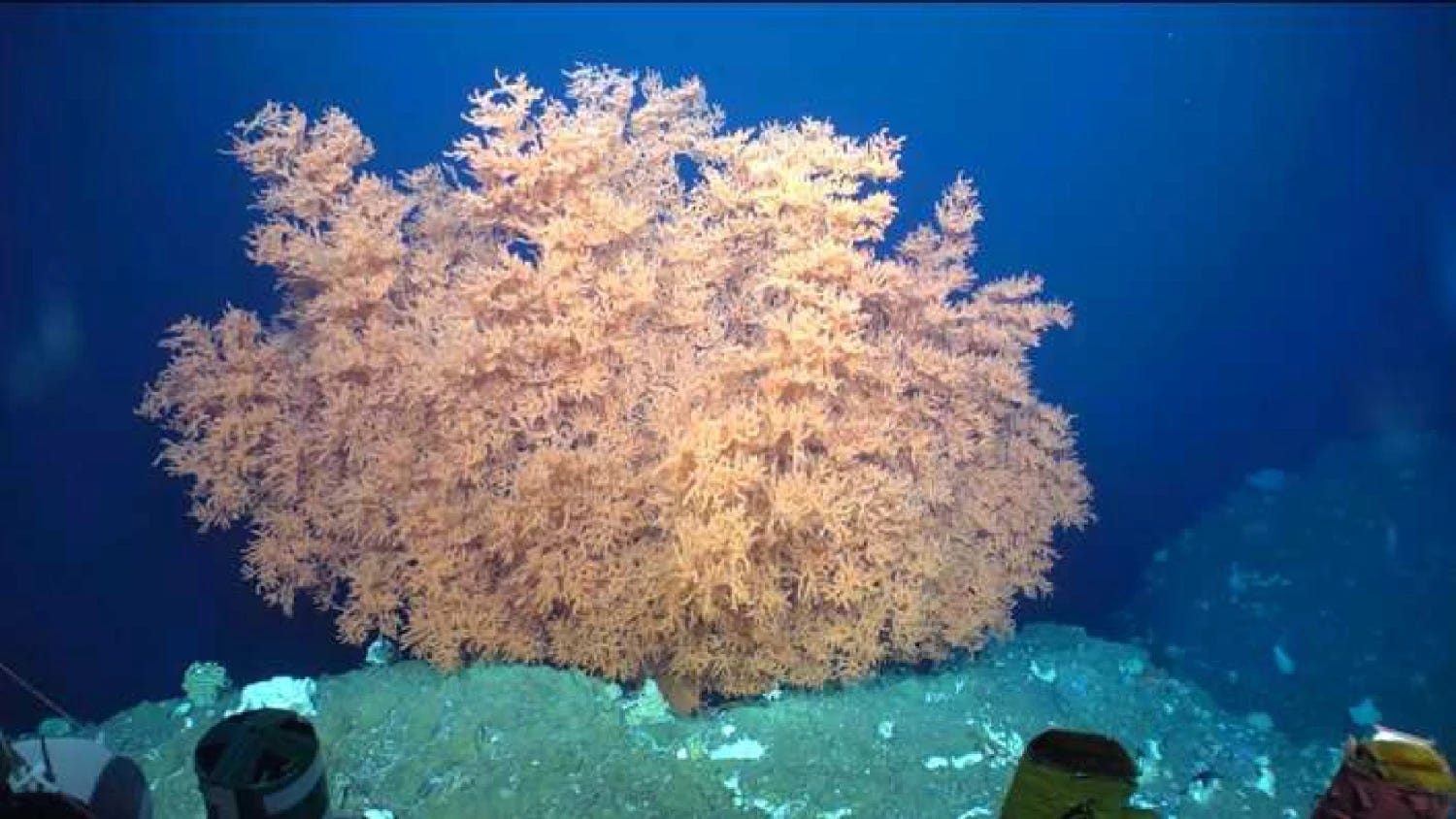
Deepwater black corals like this are known for their longevity. (“Black” refers to the color of their skeletons.) Researchers think this coral is the species Leiopathes annosa. “Annosa” literally means “long-lived.”
These kinds of corals have growth rings, similar to trees. Scientists have found other Leiopathes annosa corals that are over 4,000 years old. So, while 7,000 years is a lot older, it’s not far-fetched for a species whose lifespan measures millennia. (The researchers didn’t want to invasively sample this one, possibly damaging it, to look at its growth rings for an exact number. Instead, they estimated its age based on its size.)
Is 7,000 years super old for Leiopathes annosa? Is it an average lifespan? Are there other, even older ones out there? More research can unveil the answers about this species, which was only described by scientists in 2015. It had been found earlier, but not recognized as a new species.
Kind of like trees on land (which also have impressive lifespans), corals are habitats for other living creatures. Scientists call them “ecosystem engineers.” By forming a sort of underwater forest, they shape the communities around them – sometimes for thousands of years.
Such undersea forests are often found on seamounts. The seamounts offer a hard surface for the corals to grow on, and their shape helps nutrient-rich ocean currents flow near.
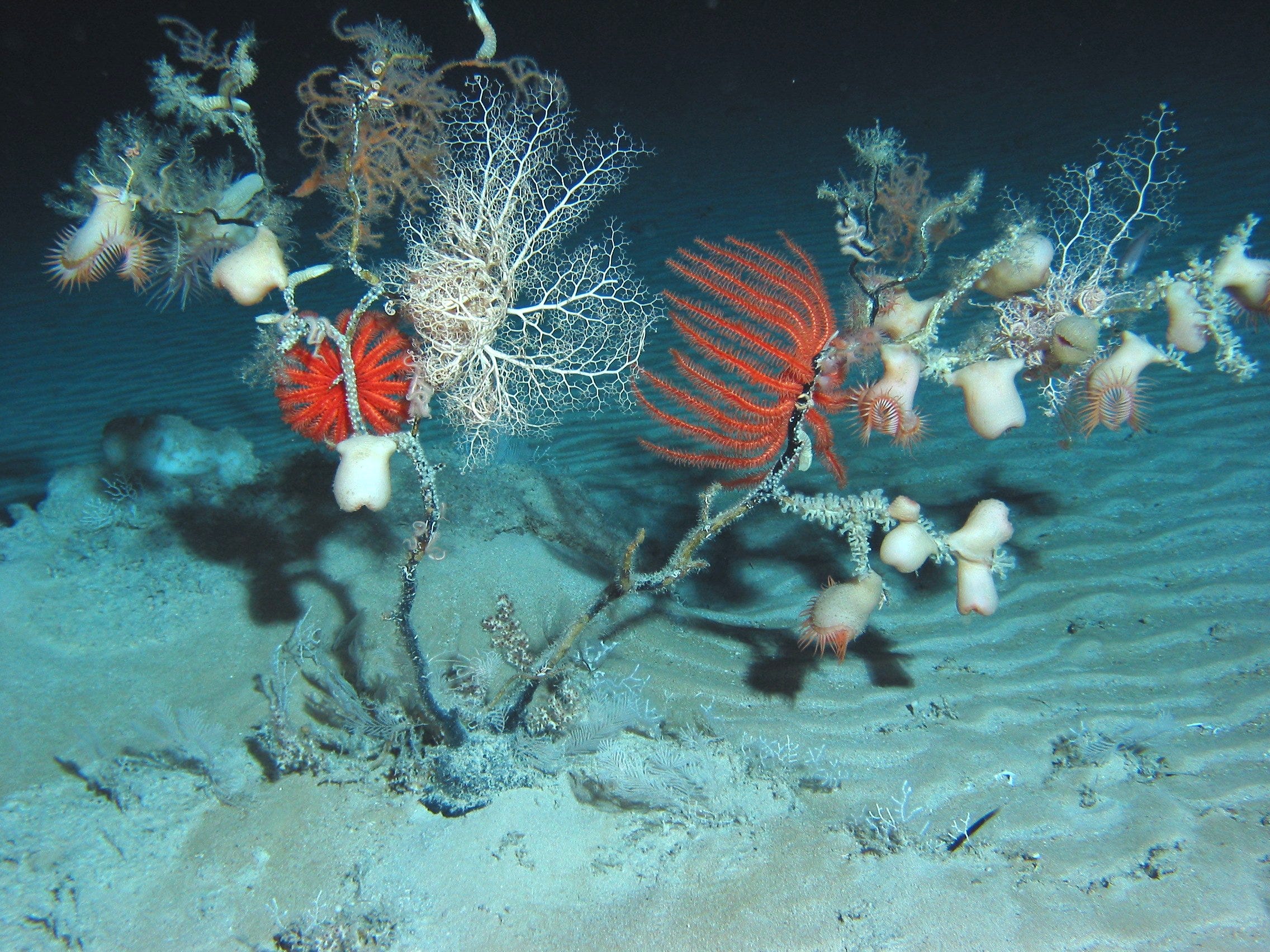
Seamounts also offer a place for minerals to settle, over the millennia. That’s why deep sea miners are interested in stripping seamount surfaces. But finding a 7,000-year-old coral highlights the value of placing these areas under protection. As a hotbed of biodiversity, and a potential source of scientific discovery, a seamount’s real value is likely much higher than the short-term monetary value of the resources on it.
The researchers who found the amazingly old coral also found all kinds of life on and around it: a cutthroat eel, a spikefish, king and spider crabs, basket and brittle stars. Nearby, they saw more corals; a sponge, sea urchin, and squat lobster; various kinds of fish.
But that’s almost certainly not all that lives there. Imagine going into a forest and counting all the species that you see. You’re likely to miss some, even in broad daylight. Now, imagine it’s a dark night, and all you’ve got is a flashlight, which you’re actually operating remotely by robot. How much will you see, and how much will you miss?
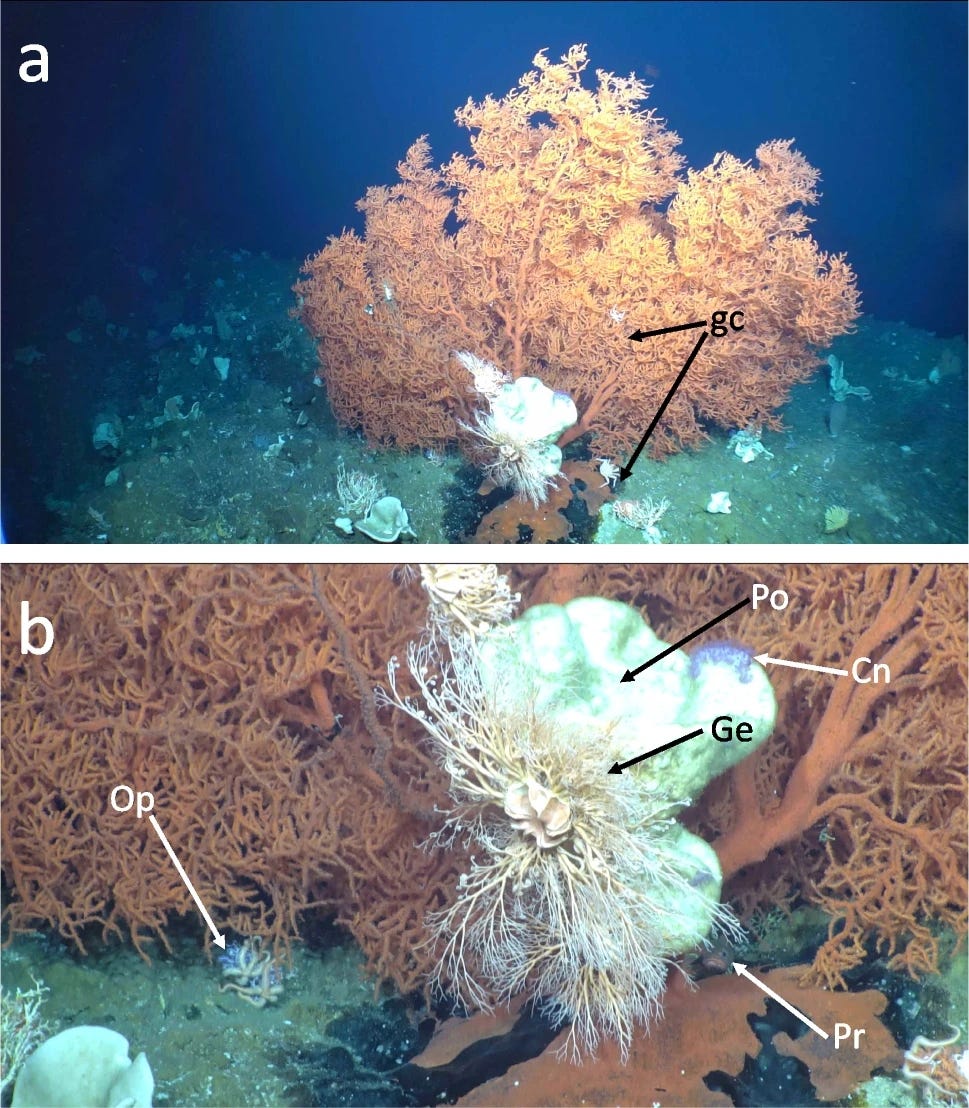
Even the best seamount studies – whether by a deep sea mining company or an independent science organization – can’t reveal all that lives there. It’s only by protecting seamounts, which are known biodiversity hotspots, that we can preserve their life, both known and unknown.
Luckily, the 7,000-year-old coral’s seamount is already in a marine protected area of Japan. But many seamounts worldwide don’t have such protections – and some are already being explored for deep sea mining. Outside of protected areas, mining and other human activities can also cause damage that reaches those areas.
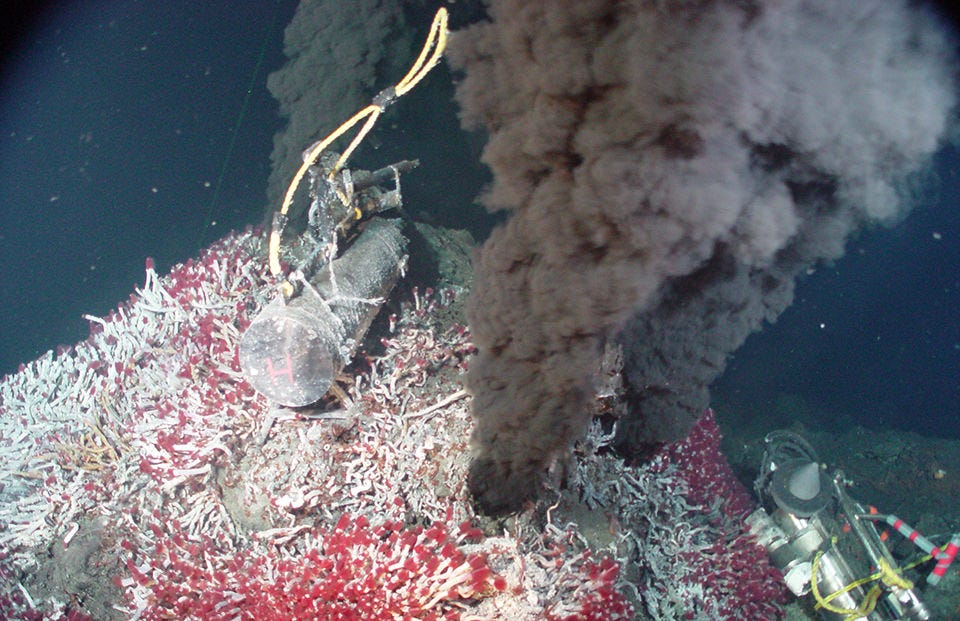
Hydrothermal vents, another possible deep sea mining target, deserve similar protections. (A new inactive vent system was just discovered in the Norwegian Sea, sparking interest in its copper content.) These vents also host rare and hard-to-study life – even rarer and harder-to-study than seamounts’ life. In vent habitats, where species are unique and closely connected, a single species extinction could tip the whole ecosystem into collapse.
“So what?” some may ask. We could obliterate many of these super-remote ecosystems before the harm becomes widespread enough to reach humans.
But these deep sea environments may hold not just rare life, but keys to understanding life itself.
Recently, in the Mariana Trench, scientists found that tiny pieces of a hydrothermal vent were converting energy. Energy conversion is a feature of life: basically, these vent parts were doing something that cells do. But they weren’t alive. They were tiny structures in a decidedly unalive geological formation, acting weirdly akin to life.
Such structures could be the missing link between life and everything else.
Even people who aren’t into cool and unique deep sea life – even those who don’t want to protect creatures simply because they exist – might still want to solve the mystery of how life came to be on Earth. Deep sea formations can help us do it. But only if they’re preserved for future research.
Scientists always hope they’ll stumble on something really cool and useful when making a deep sea expedition. But what they’ll discover there, given how hard it is to study, is always kind of a gamble. By protecting the most unique deepwater environments, we can increase the odds of winning.