Beautifully Solving the Problem
An interview with Meghan Jones
Notes from the Deep periodically features interviews with artists, academics, and other experts doing interesting work that relates to the deep sea.
Meghan Jones has a BFA from the Alberta University of the Arts. She spent 15 years designing knitting patterns for yarn companies and magazines like Vogue Knitting before returning to her fine art roots in 2021. She primarily works in acrylic on canvas and graphite on paper but also dabbles in mixed media.
A chance connection with deep sea scientists and photos from the deepest of ocean habitats captured her imagination in 2023 and rekindled a childhood love of all things science. Meghan has a painting hanging in the Minderoo-UWA Deep Sea Research Centre in Perth, Australia, and reads as many science and nature books as she can.
Meghan lives in Spokane, WA, US, with her four kids, four cats, two dogs, and one husband. Besides the deep ocean, she also nurses obsessions with gardening, cooking, composting, and tattoos.
This interview has been edited for length and clarity.
Elyse: What was the first deep sea creature you ever painted or portrayed in art? What got you started as a deep sea artist?
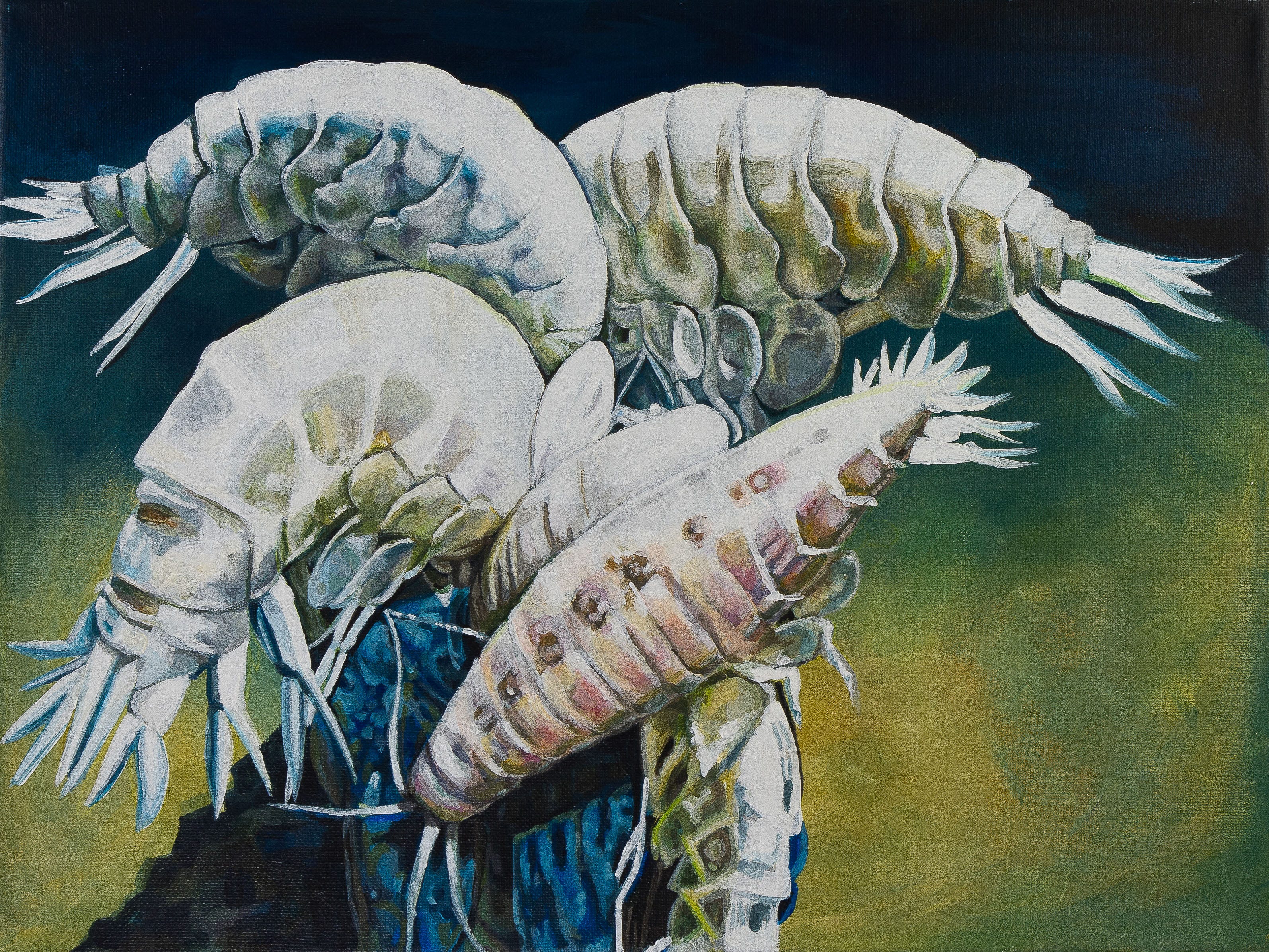
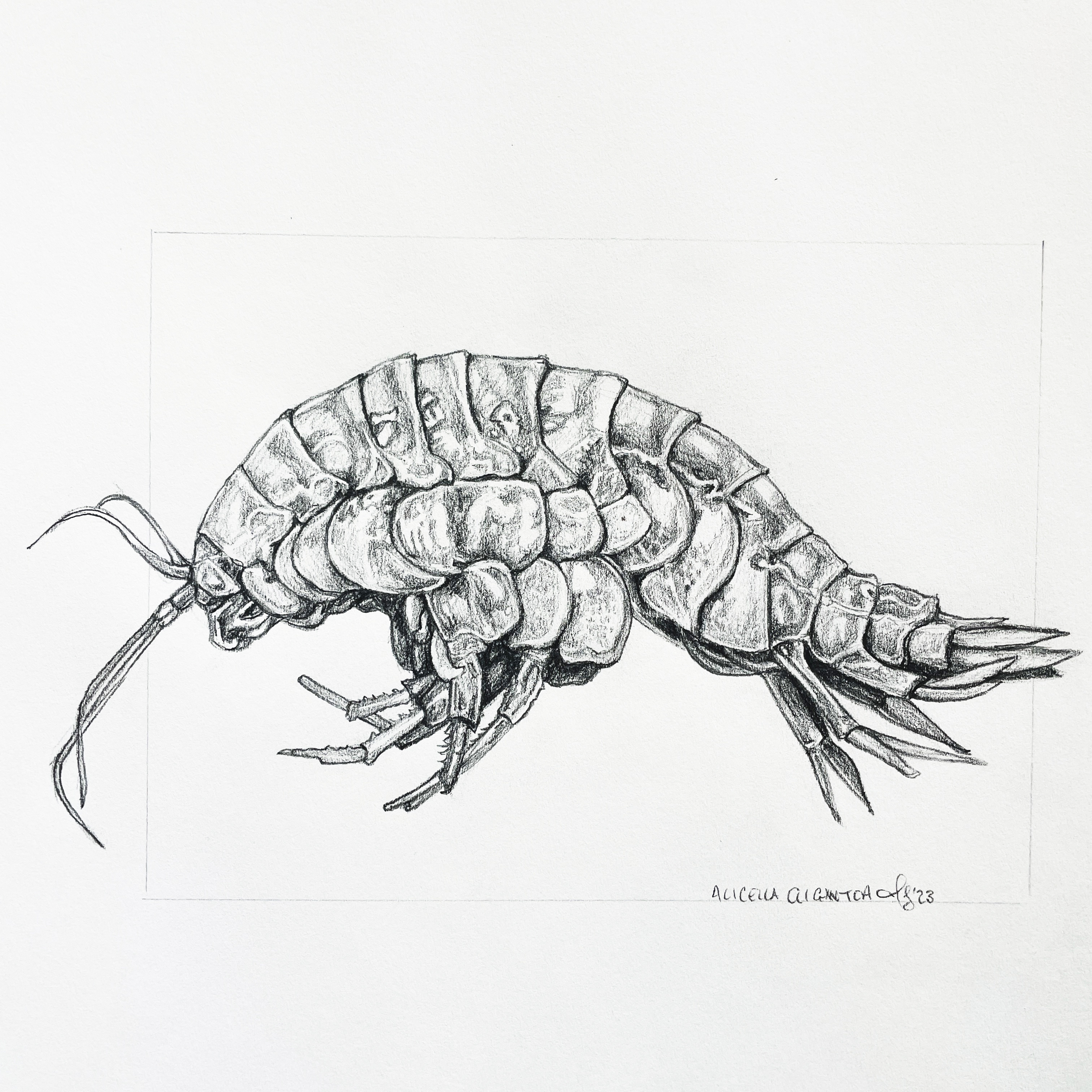
Meghan: Oh, good question. So the first sea creature I ever portrayed was a bigfin squid. And I had worked on a series of cephalopods and flowers together. But the first, like, proper deep sea creature was a supergiant amphipod: Alicella gigantea. And it was from a photo that Professor Alan Jamieson took – he’s the director of the Deep Sea Research Centre in Perth, Australia, at the University of Western Australia.
He posted this photo that he took of the supergiant amphipods in the Murray Fracture Zone. And it just blew my mind. It was so beautiful. And so that was the first one that really got me hooked. That was my gateway drug, right there. That was the one. [Laughs.]
Elyse: Did you have a background in art or natural science that led you in this direction?
Meghan: I have a Bachelor of Fine Arts. My first three and a half years were really, really heavily drawing- and painting-oriented. I was actually three classes away from graduating with a drawing degree. But I switched my major just at the very last second in my third year of school. I had taken a fiber elective and I just got really into it. So I ended up graduating out of the fiber department.
I took two years of school in a year and a half. I was running back and forth between classes, taking them at the same time. I’m really highly motivated, so I loved that. And I graduated with a degree in weaving on a computer-generated loom and Japanese wax resist natural dyes, believe it or not. Neither of which I do anymore, because they’re huge processes and they’re not really safe around kids or they just take tons of time.
I’ve always been obsessed with the ocean.
I ended up spending 15 years designing knitting patterns. I worked for Vogue Knitting Magazine; I published a lot of patterns with them, with Interweave Knits Magazine, yarn companies like Plymouth Yarn Company. I actually published a book of knitting patterns, which is a kind of technical writing.
So I took a long break from art, but then I just kind of came back to it. And I’ve always been obsessed with the ocean.
When I was in grade five, maybe, I read a book about a coelacanth obsessively. I took it out of the library for an entire year and just read that book over and over. So, I’ve kind of always been into it. I just didn’t know I was for a while there.
Elyse: And nowadays you’re painting and drawing a lot of deep sea fish and cephalopods. I’m curious how you approach portraying these creatures, which are very different from each other – you know, how they move and how they live – and also from humans. Do you have a strategy for capturing them in art?
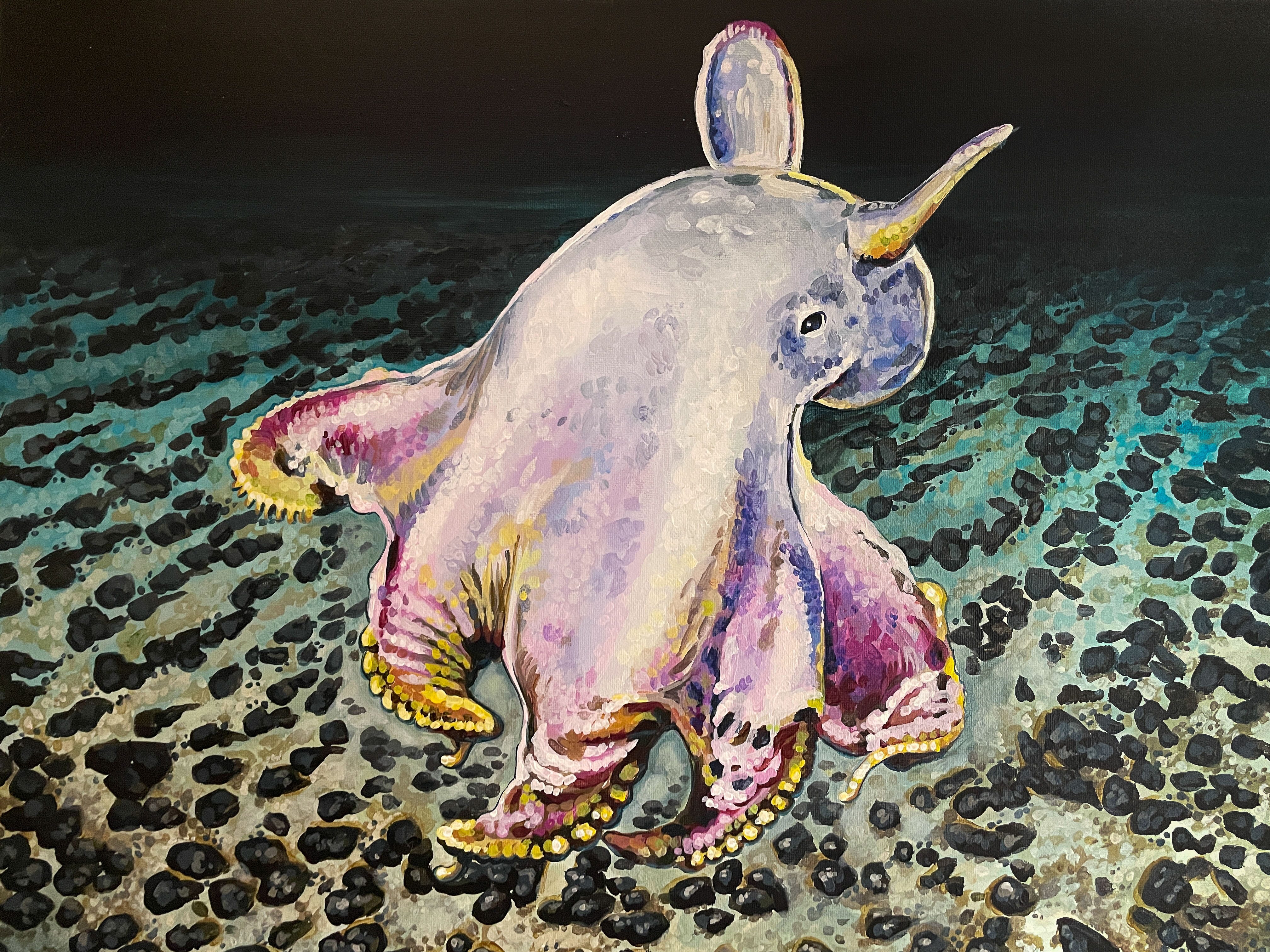
Meghan: Yeah. I think when it comes down to portraying forms, transferring forms from 3D to 2D, I try to just flatten them into chunks of shape and color. That’s really my motivation when I’m working with these images: not making any assumptions, because that’s where you get yourself in trouble and that’s where things can get really out of proportion. You’re thinking to yourself, Oh, I know what this looks like. Well, you don’t really – you’re looking at it, that’s what it looks like. You don’t know. Just look at it and work with the shapes and forms you actually see.
It really has a lot to do with the right side of your brain, working with color and working with shape and trying not to talk a lot because that activates the left side. You don’t want to activate your left side, which is activated by language. It shuts down your right side and stops image and form processing.
So for me, it’s really just looking at shape and color and form, and trying to get it on the canvas, and just making it as beautiful as possible. It’s like creative problem solving, you know, beautifully solving the problem.
Elyse: Where do you get your inspiration? You mentioned painting from a photograph. Is that usually where it comes from, or are there other sources?
Meghan: Yeah, I love the photographs and I’ve been really lucky – Professor Jamieson’s been really generous with his photo permissions. You have to be a little bit careful with images from the deep sea: you’ve got to ask permission, and some places really want you to pay for permission, to use them. So he is just a really wonderful person. He’s like, “Yeah, absolutely, anything you want.” He’s a great supporter of the arts. He actually purchased the supergiant amphipod painting, which was like, mind-blowingly cool.
And the photos – I love looking at them. They’re just fascinating. It’s like, this thing exists so far away from me in a place that I can never visit. I cannot survive there. It cannot survive with me. It lives in total darkness. Talk about a foreign concept, right? I mean, we have this circadian rhythm, sunshine. We have warmth. The idea of lacking both just blows my mind and sucks me in every time.
The only way they’re illuminated is from the bright lights that we put on them.
And then the other thing I find really inspiring is Impressionism. I paint within modern Impressionism. And that’s really about light. I don’t know if you know much about Impressionism, but it’s an art movement from the 19th century. And it really was a break from the very traditional art movements that preceded it, which were really religion-centered. They were very tight, very controlled, very sculpted and blended. These movements were really high realism paintings, and Impressionism just kind of blew that out of the water.
Impressionism was all about landscapes and people. It was about working in situ, and chunks of color and movement, and sort of putting your own artistic flavor on it. How did you feel about the work and how did the light move? So Monet is a great example. You might have seen his Water Lilies, and you might see five or eight different versions where they’re all different colors. It’s because he painted them at different times of the day. He would take one subject and see how the light changed it.
It doesn’t seem like this would apply to the deep sea stuff, but the light fascinates me because they live in the dark, and the only way they’re illuminated is from the bright lights that we put on them. So it’s this very unusual juxtaposition of never being able to see the animal in situ in natural light, ever. It’s impossible. I’ll never get there, right?
And so taking this art movement that’s all about light and in situ and then translating it to something that’s in darkness and can never be practiced in situ – to me, there’s a lot of interesting conversation that can happen in there. I like working in that area and thinking about it when I create pieces.
Elyse: So when it comes to these deep sea creatures, what would you say is the most interesting you’ve ever painted? Or your favorite?
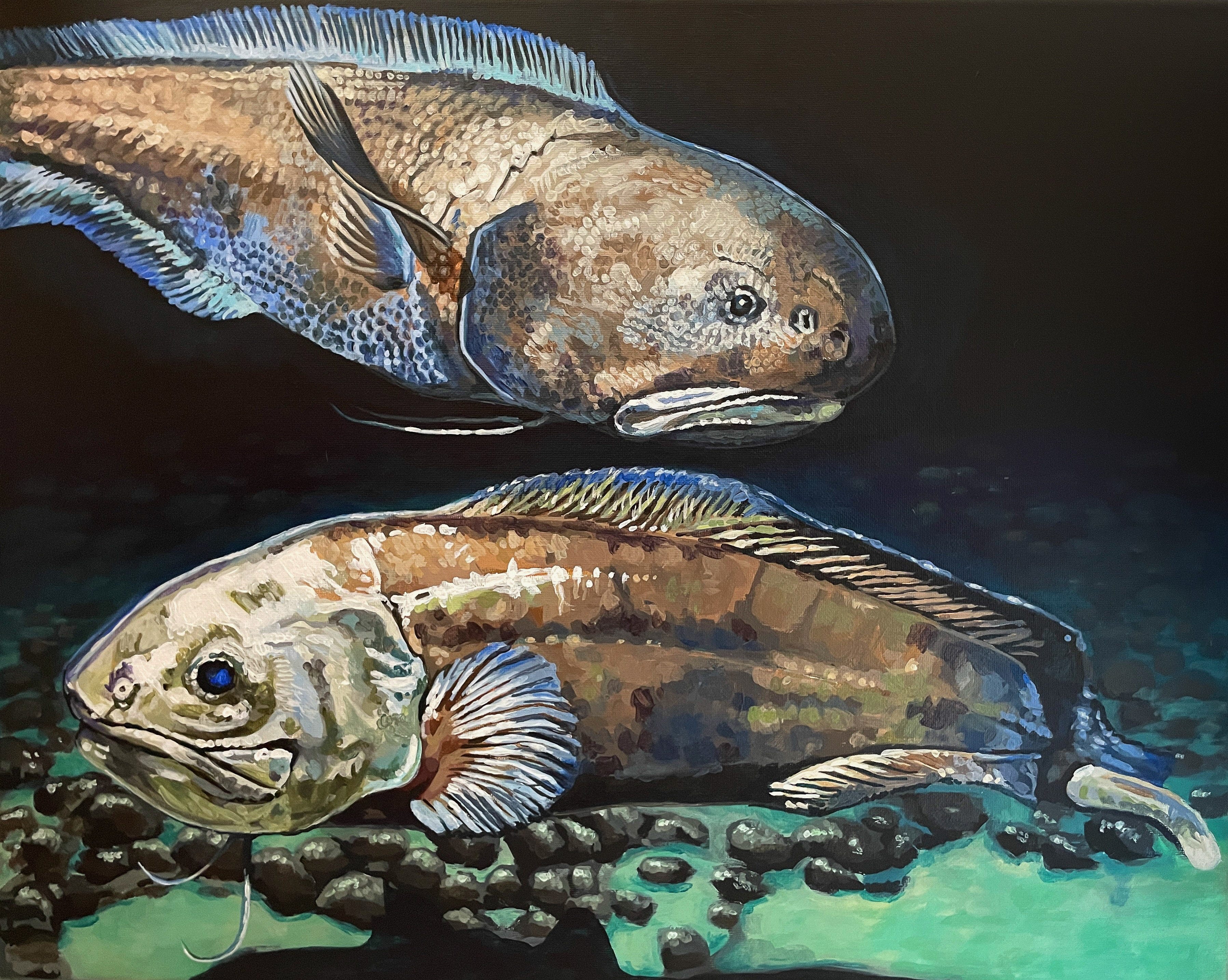
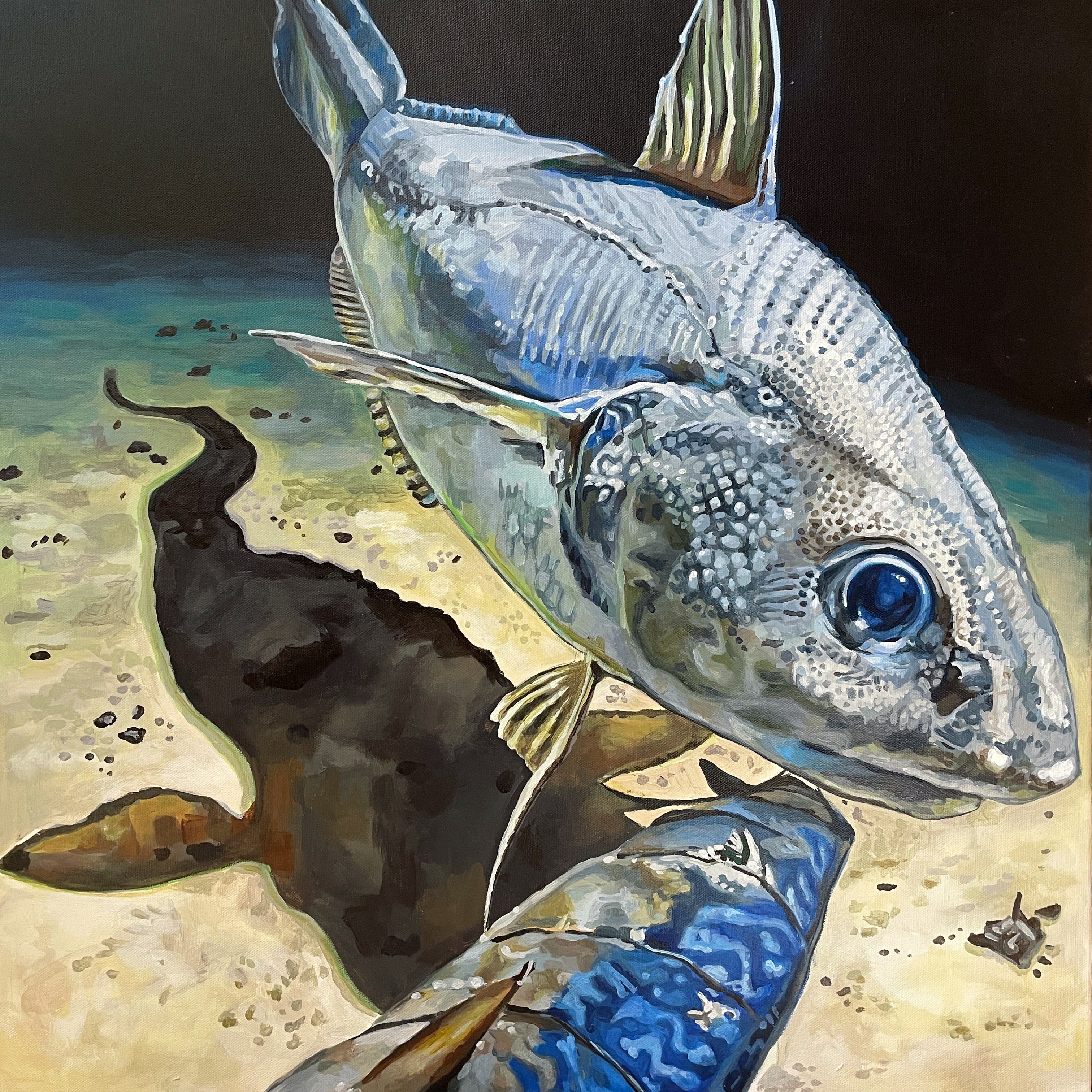
Meghan: Okay, so probably two. So I love snailfish because they’re transparent. I really love all lifeforms that have this transparency aspect to them. Snailfish are a great example. They’ve actually lost their genetic marker to create color. They’re very transparent.
And so what I see is this really cool reflection of the bright lander lights on them. You see the bottom of the ocean floor, the brown reflected up underneath them. So the bottom is sort of brown, olive colors. And then the blue from the water’s reflected down on top, so you see the bright blues because of the reflection out of the water. And then the pink is their blood inside of them. I just really love that.
It’s the same with the supergiant amphipods. They’re white, and they are really reflective. So they’ll reflect off the bait and look more blue because the bait is mackerel, or they’ll reflect off the ground and look more brown.
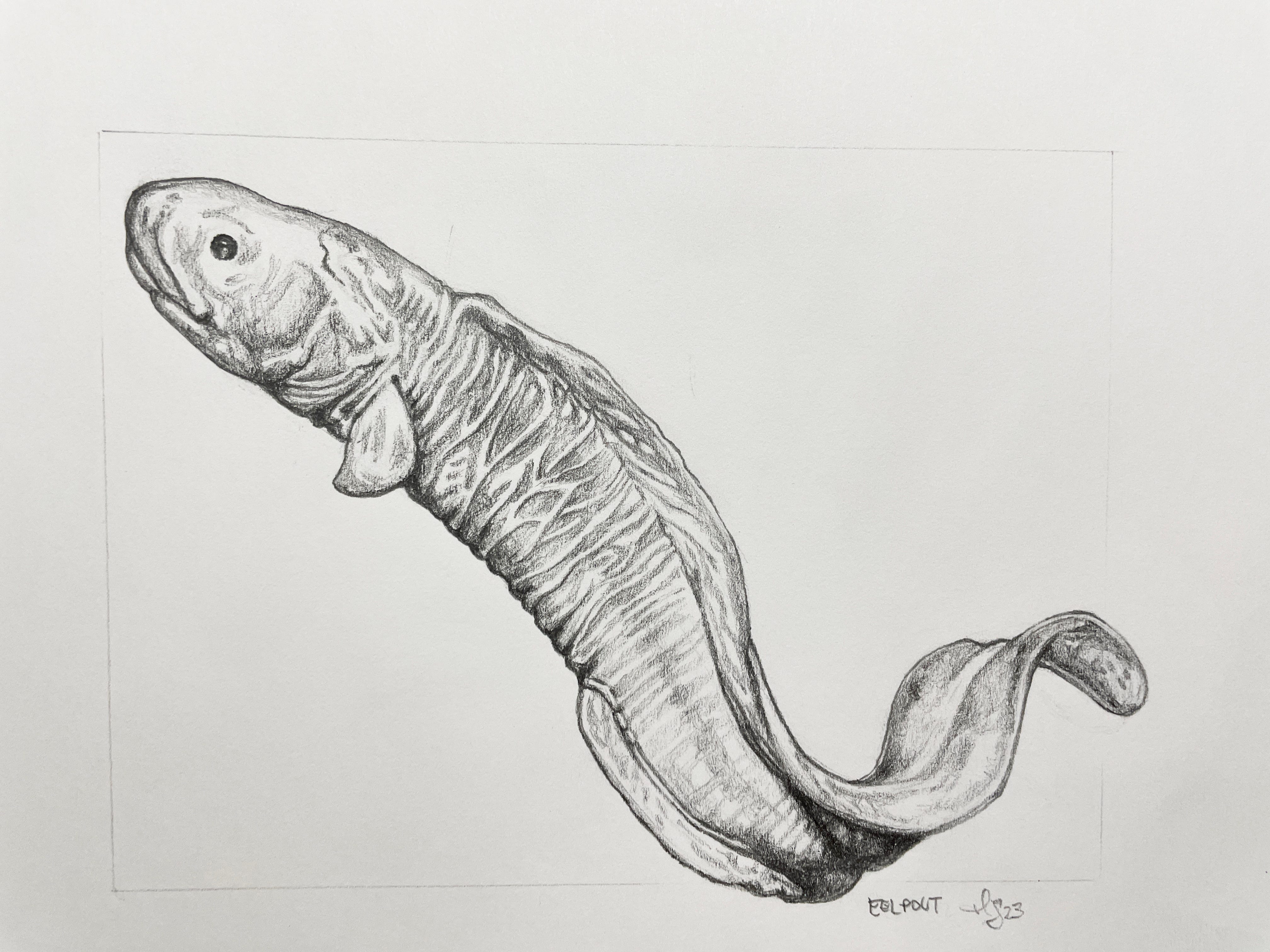
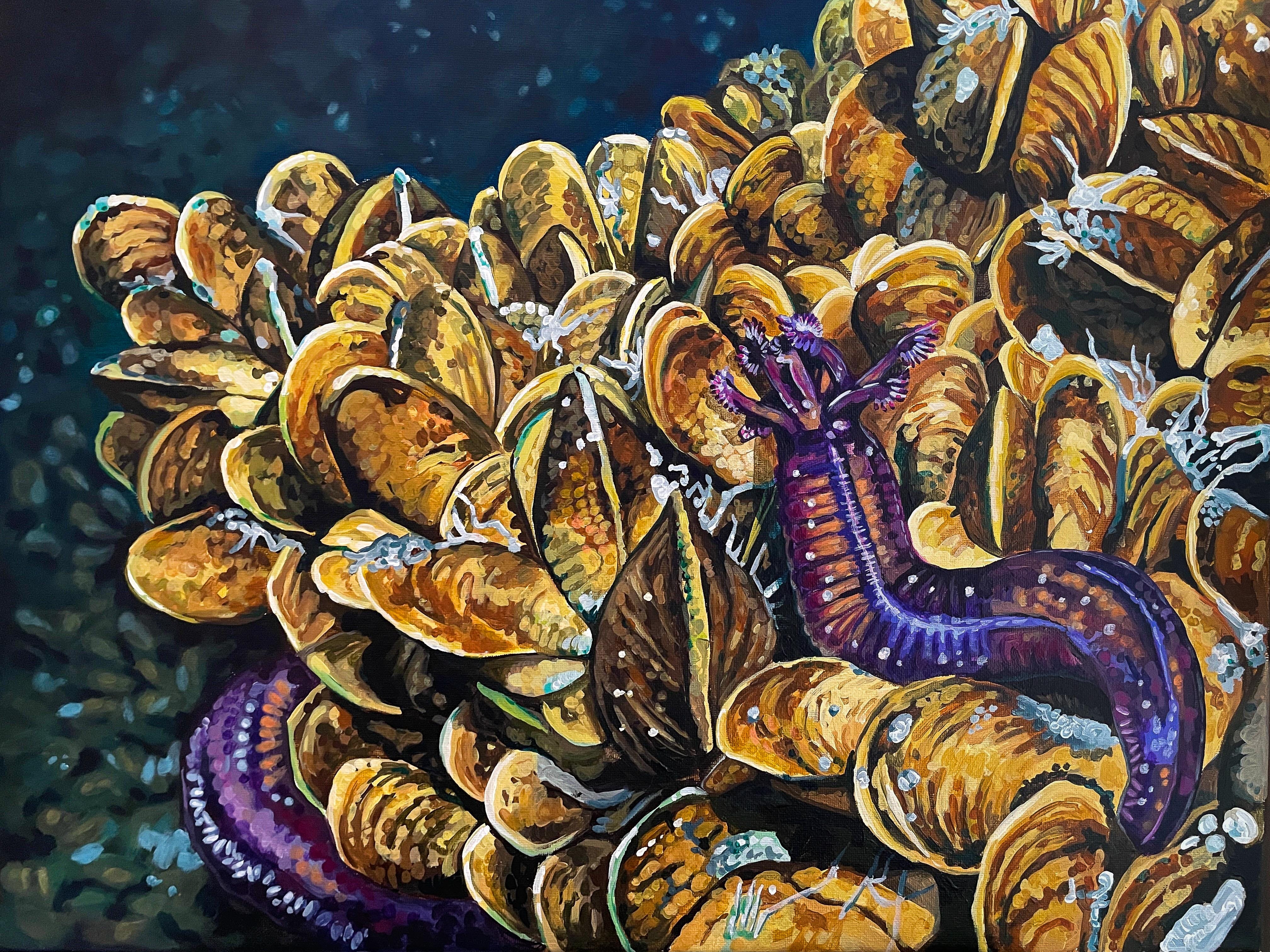
And then my favorites, the cusk eels – the Spectrunculus grandis and Bassozetus robustus cusk eels – because they have these big frowning mouths. They just look grumpy: they’re chunky and grumpy and I just love them. They look like they have big personalities, you know?
Elyse: Has portraying deep sea creatures in art brought you new perspectives on marine ecology or conservation?
Meghan: Yeah, absolutely. I don’t think I really knew how much was down there. I was absolutely in the camp of, “No, it’s a desert. There’s nothing there,” you know, which is absurd. But at some point I decided that the other adults had figured it all out and there was nothing else left to discover, which is a lie, because it feels like none of us really ever grow up into adults.
So it feels like exploration to me. Every time I look at a new photo, every time I watch more ROV footage, it just kind of blows my mind. I’m like – it’s so amazing how much is down there. We can’t access it. I’m a real hands-on person; I like to touch things. And the idea of, “It’s there and you can’t go, Meghan, you just can’t, you’re not allowed, you’re not the right flavor. You don’t have gills, you don’t have TMAO or you don’t have enough TMAO to make the pressure work,” you know? I like that part of it a lot.
It’s so amazing how much is down there.
And I’ve learned a lot more about the perfect trifecta of the habitat and how the habitat informs the adaptation that informs what the animal needs to live. It’s just this perfect balance. And coming at it from an outsider’s perspective, it’s not like here in my home where I’m like, “Ah, yes, it’s a cat, it’s adapted to my home.” It’s really foreign and so therefore it’s very exciting to me.
It’s a beautiful landscape that’s completely under the water. I’m endlessly fascinated with just how many habitats there are, and also how much ocean geography really factors into the habitats.
Elyse: I know you have a children’s book coming out. When can we read it, and what’s your approach to sharing the deep sea in that format?
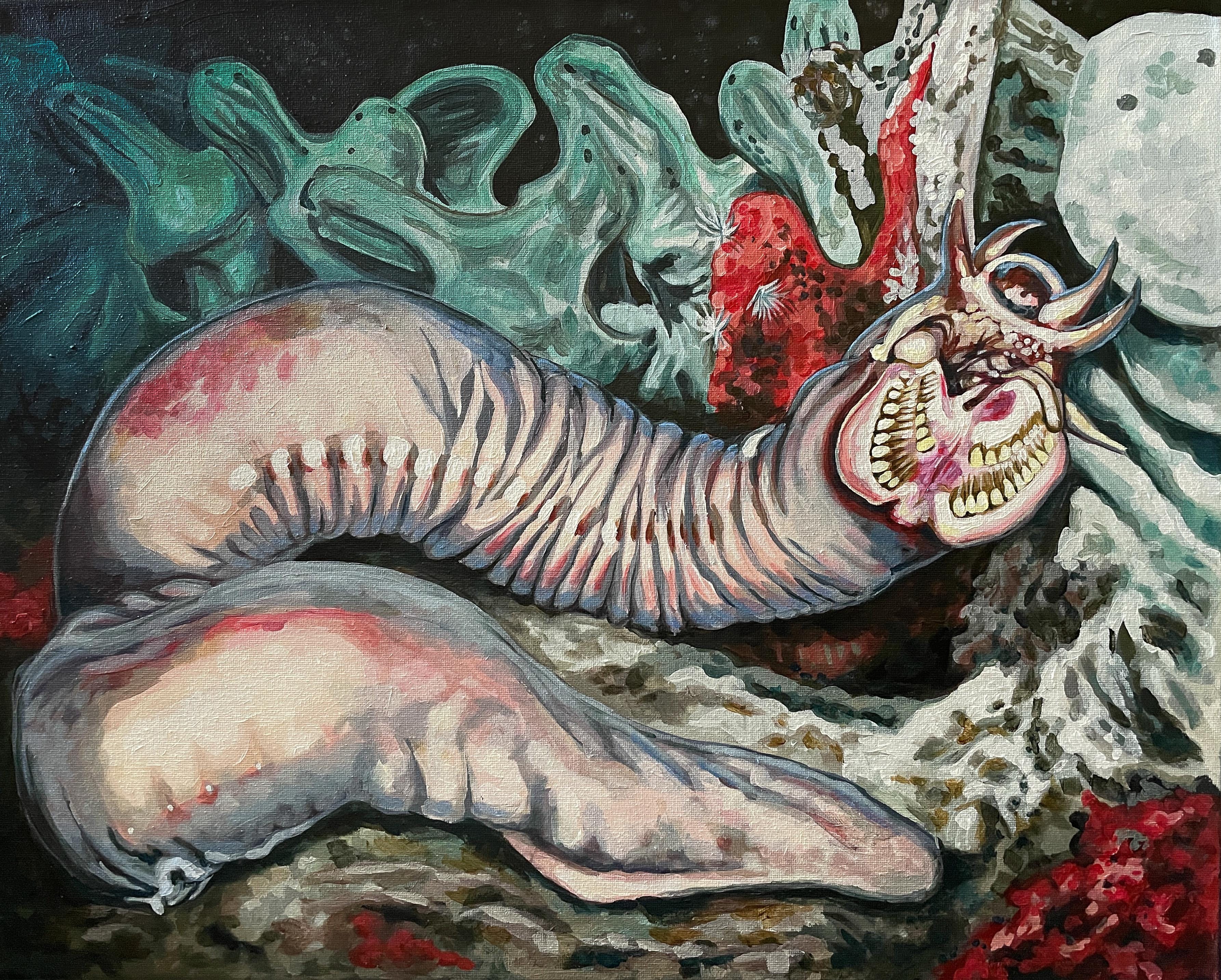
Meghan: I have a contract with Roman and Littlefield, which is a publisher here in the US, and they publish primarily children’s nonfiction. The book is tentatively titled The Unusual Ocean: Who Lives in The Deep? And is slotted for a 2026 release.
It covers seven different deep sea habitats, and approximately 19 different organisms. I keep adding more [laughs], so I’m gonna say approximately. And it’s just really working from the shore to the deepest sea in this straight line, considering what might you encounter on the way? How does the geography impact the habitat? Which then impacts the animal, which then impacts the adaptations. And presenting it in a fun way for kids ages 9 to 12.
It’s icky fun, but no sensationalism. We are not using words like bizarre or alien or strange because those are bad words that actually hurt the public perception of the deep ocean.
Elyse: What would you like more people to know about the world of deep sea art?
Meghan: I think if we were gonna talk about one thing: the intersection of art and science is a really special place. And if you’re into art and you like science, don’t be shy. Get in there. You’d be really, really amazed at how friendly the deep sea community is. They’re just really kind and welcoming and people are really willing to help you.
It’s important to know that there’s space for everyone. It’s not a piece of pie. I really subscribe to “A rising tide lifts all boats.” And the more people that are putting energy toward protecting the environment and deep sea stewardship and trying to help, the better it is and the more you can lean on each other, collaborate, all that kind of stuff.