Opening Pandora’s Box
An interview with Dr. Keron Niles
Notes from the Deep periodically features interviews with artists, academics, and other experts doing interesting work that relates to the deep sea.
Dr. Keron Niles is a lecturer at the Institute of International Relations at the University of the West Indies. His work focuses on problems that arise at the intersection of climate and energy policy. Dr. Niles has been researching the link between industrial policy, international trade, and climate change in the Caribbean since 2008. Within the last five years, his research has also focused on assessing cultural industries as a pathway to low carbon and circular economic growth.
Dr. Niles is also Managing Director of Koru Green Ltd, a firm dedicated to commercializing creative content throughout the Caribbean. Koru Green provides management, marketing, and research support to creative professionals who wish to find new markets for the content they produce and/or to expand the consumption of their works within markets in which they are already present. To this end, it should be noted the company currently represents the dynamic musical band known as Freetown Collective.
He is also a published poet and has been a certified youth worker for the past 23 years. He holds a bachelor’s degree in Government (with minors in History and International Relations) from the University of the West Indies and a master’s degree in International Law from the University of Aberdeen.
This interview has been edited for length and clarity.

Elyse: I think it’s common to view today’s transition toward renewable energy in a vacuum, or as the first energy transition. But you contextualize it as the latest in a series of transitions. And of course, this is relevant to deep sea mining, which would possibly be one way to get materials for things like solar panels and electric cars. Can you talk a little bit about that history and why we need to look at past energy transitions to inform this one?
Keron: Well, there are some key things that have driven civilization since the dawn of time. We’ve needed food, we’ve needed shelter. Maslow has helped to articulate that. But we’ve also needed energy.
For a long time, the energy that we used as humans was kinetic energy. It took a while for us to actually employ animal energy. You can think about the domestication of animals, and how humans employed animals not just for transportation, but also for agriculture.
Why am I saying all this? Well, when Europeans were searching for a new route to India, Columbus went west instead of east because there were wars to the east. And the trade winds brought him to the Caribbean. So, found himself here and he found the persons engaged in subsistence agriculture. And they were, of course, using human energy, which is kinetic energy, and animal labor as well.
But essentially, the question is: how do you produce the energy that you need to have the production that you want?
The Europeans wanted commercial [crop] production. And so they enslaved the Indigenous population, which killed 95 percent of them, which then led them to bring my ancestors – enslaved Africans – to the Caribbean region.
And that was a large-scale employment of human energy, right? Until, of course, the Industrial Revolution.
Then, coal fed machines, and they didn’t know that that was going to lead to climate change. But they did know that machines did not revolt.
And coal didn’t just have industrial applications. It also had residential and domestic applications as well. One thing people can do is to ask [their elders] about when coal was used to cook in their houses. Many of our grandparents and great-grandparents would’ve used coal to cook.
And then the first energy transition in modern history was the transition from coal to gas.
Coal fed machines, and they didn’t know that that was going to lead to climate change.
Many houses use gas now for cooking. And those gas pipes in your house took years to build, in terms of new developments with gas, plumbing, and ensuring that they had the infrastructure to supply gas to every dwelling. That’s not something that existed in the time of our grandparents.
And now we face another transition, away from gas and away from oil.

Elyse: That full human history is so important – to understand where we’re at now, we have to understand where we came from. So, how does deep sea mining fit into this picture? Is it similar to past forms of extraction, is it part of this latest energy transition, or is it something a little bit different?
Keron: All of the resources that you use come from somewhere, right? The resources that powered the Industrial Revolution took us into very deep, dangerous mines. And lots of people died in these conditions.
And the energy transition that happened after that took a lot of technology to go to land and sea, in deep blue waters, to drill for oil and gas. These were very similar pictures, right, to extract this resource.
What we are seeing now is not a new picture. We’re going into the deep sea. This time, instead of drilling into the ground, we’re about to scrape the ground, in the hope that all of those minerals that are there can help to power the next transition.
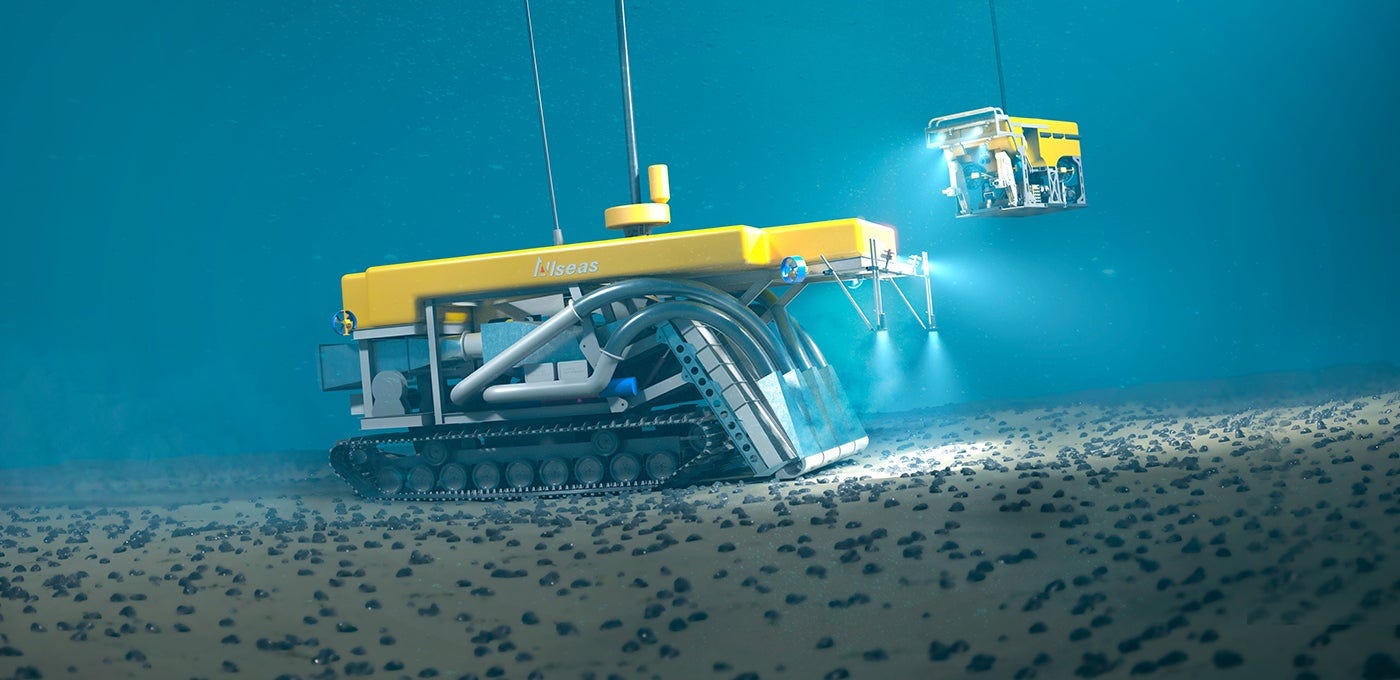

But I think the greatest difference is that the transitions before were geared directly toward extracting fuels.
Going into those deep mines was to get coal, which was a fuel. Going to get the natural gas was to produce a fuel. Deep sea mining is not necessarily to get a fuel. It allows us to get the minerals and the materials to build the machinery that allows us to use new fuels, new sources of energy.
So it’s slightly different. It’s not like we’re gonna scrape the ocean floor and whatever we find there is an important new fuel. But what we find is gonna be used to build a battery that’ll be a component of a more sustainable form of transport.
And that becomes a more tricky equation, because it’s easier to model out how much fuel you need if people are getting fuel directly. It’s easier to say, “Okay, we know people are gonna use this amount of the cooking gas, so we can see that there is a market for X amount of cooking gas.”
But number one, we don’t even know what’s on the seafloor to begin with. We have no idea what quantity [of minerals] is there. So we’re gonna get minerals, right? And these are gonna go into a wide variety of processes. Some are gonna end up in phones, some are gonna end up in electric vehicles. And it’s because of that that we now find ourselves in a very interesting place.
I think the least we can do, if we’re taking these materials off the seafloor, is to make sure that they’re going into circular processes, so we don’t have to keep going and getting the same things over and over again. If we can begin to put these minerals into circular processes, at least we don’t have to keep scraping and scraping and scraping. But [right now], we don’t even know how much we need.
We don’t even know what is on the seafloor to begin with.
Part of the reason we don’t know how much we need is because we’re using [these minerals] for so many things. And because we’re using them for so many things, that is a kind of justification to just scrape the entire seafloor area until there’s nothing left to scrape. That, to me, is one area of difference that I think we need to pay attention to.
Elyse: It’s really important to note that renewable energy projects aren’t the only uses for these minerals. They can go in electronics of all sorts.
Keron: Yeah, I mean, we have Elon Musk and others saying blatantly, “I need more nickel, I need more cobalt.” But it’s not going into any one thing. [These minerals] might find themselves in weapons as well, in military uses. Some of those uses are not gonna be circular at all.
This, to me, is opening Pandora’s box. I mean, failure would be bad, but it will not be as detrimental as success. If they find something that they didn’t expect to find, but it’s an amazing mineral that’s even better than some things they’re using now, that’s going to create a massive incentive to go get more.
Elyse: Definitely. And you’ve spoken and written about the tragedy of the commons, which seems very relevant at this point. Can you talk a little bit about how that applies to deep sea mining?
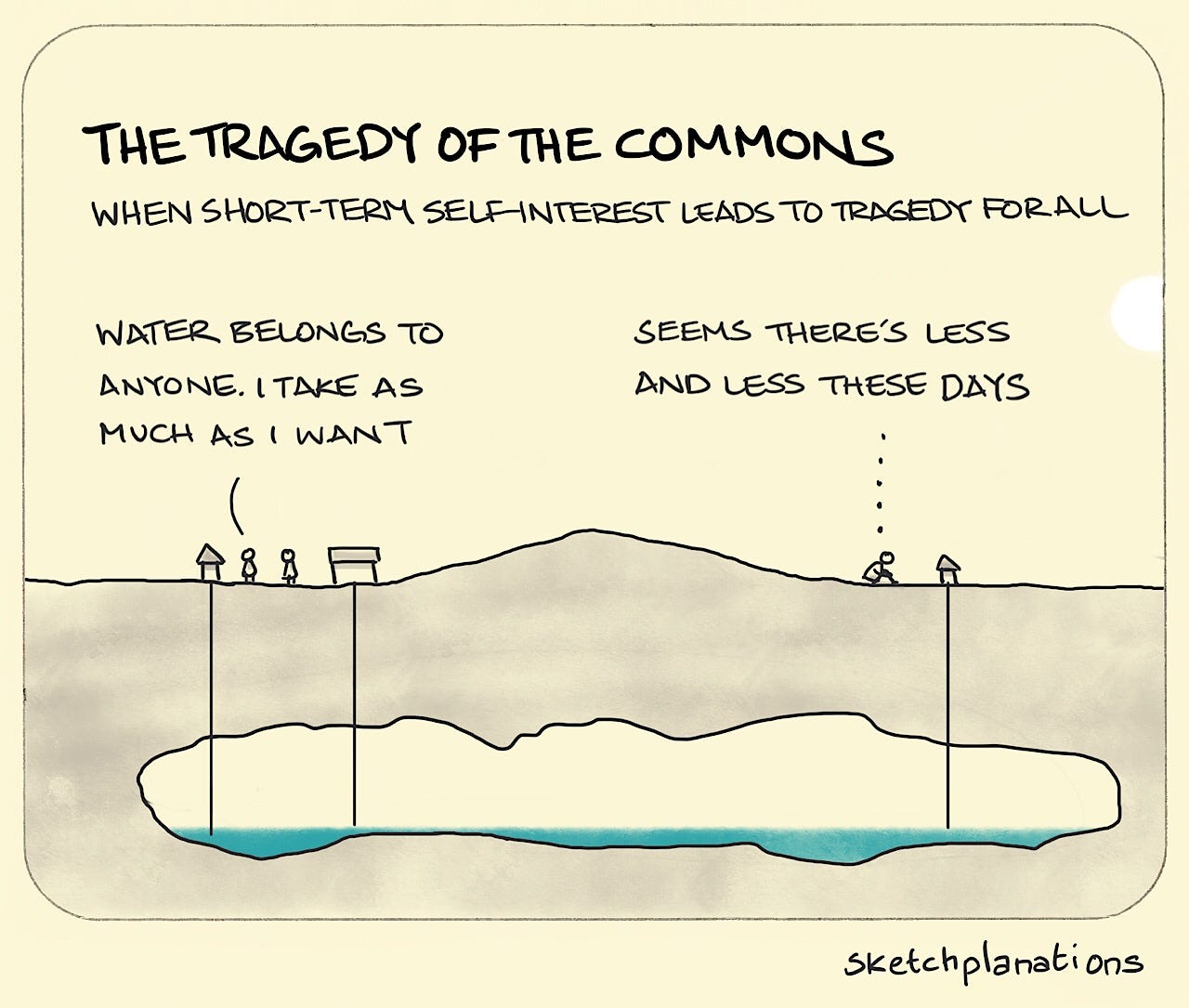
Keron: So the tragedy of the commons simply says that if two persons or two groups want the same thing, unless they come to an agreement about how it’s going to be stewarded, they’ll both keep extracting that resource [until there’s none left]. Because no one wants to be the one to lose from walking away, right?
We’ve seen that happen with whaling, and with tuna to some extent. And we saw it happen with slavery. No one wanted to give up free labor. I mean, that is – if you think about it only from an industrialist or an economic perspective – a sweet deal.
And we now find ourselves in a tragedy of the commons with oil and gas. No one really wants to stop [extracting], because if you stop, you’re gonna be walking away from quite a lot.
How is that related to deep sea mining? Well, if there’s no agreement in terms of how it should be done or what the rules are, then the danger that we face is not failure – the real danger is success.
If it’s successful, it would trigger a tragedy of the commons scenario because everybody’s going to want to get in and no one is going to want to not profit. No one is going to not do it in the name of morality. If they didn’t do it for slavery, they’re not going to do it now.
The danger that we face is not failure – the real danger is success.
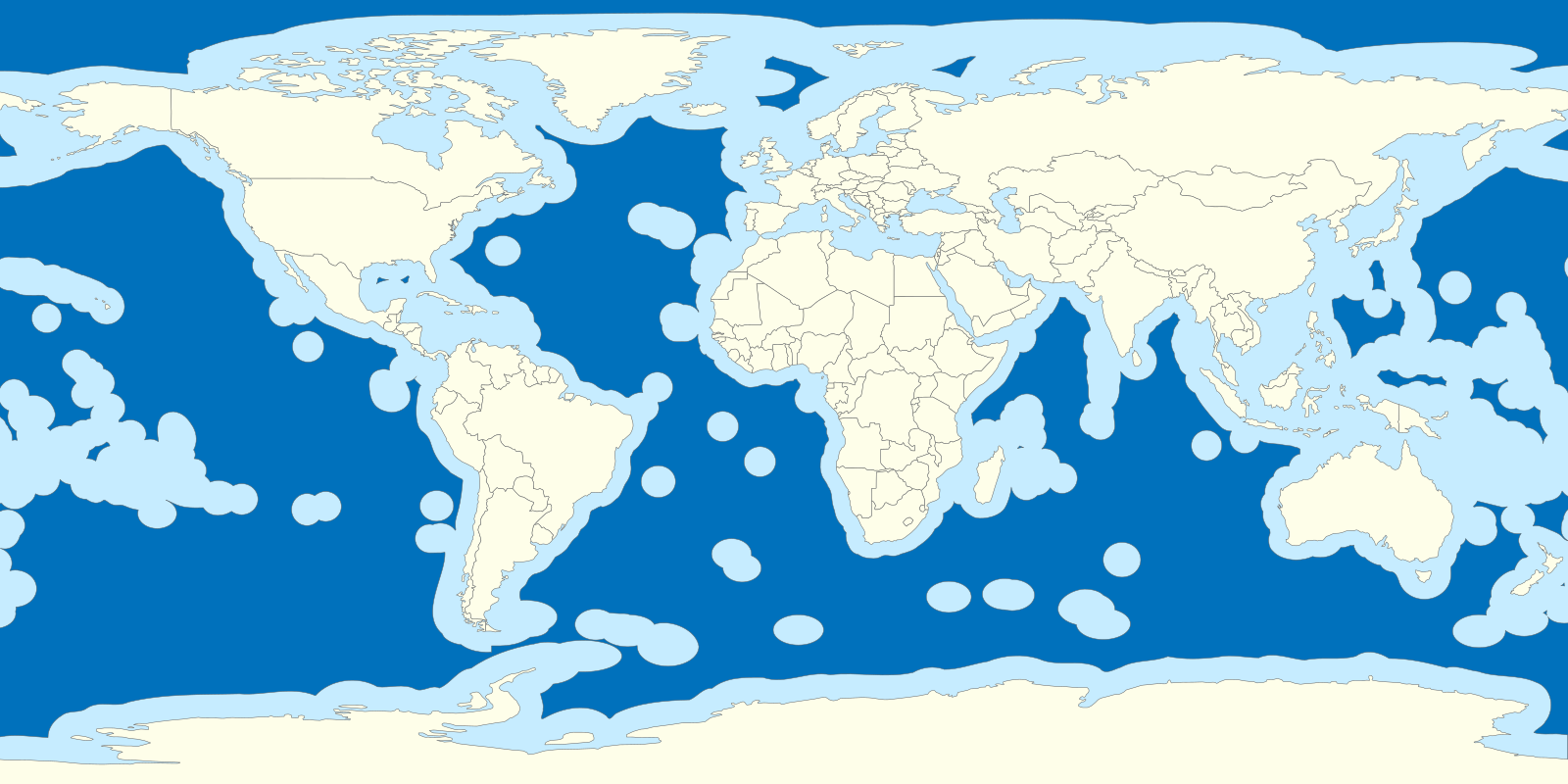
It can definitely trigger that [scenario] without strong regulations. And so it becomes really critical for the International Seabed Authority to step up and avoid a tragedy of commons if we do find ourselves in such a situation. But the question, of course, is who’s gonna enforce [those rules] in the deep sea?

Elyse: So we now risk repeating the evils of past energy transitions in a new way. How could we do things differently this time? Is it a matter of regulation, or are there other things that need to happen to do this transition to renewables well?
Keron: The key thing about this transition is that we’re going to need to think about it in multiple dimensions and on multiple levels.
On one level, it’s about the sustainable energy transition, and how we get these materials to power solar energy and other renewable energy forms.
So we need to keep our eyes on how this is affecting our insatiable drive for energy. But on another level, we also need to look much more carefully at how it affects material production and manufacturing.
And there’s one more [level]. Strangely enough, and I tell my students this all the time, a lot of environmental law and a lot of environmental policy has nothing to do with the environment. We’ve made environmental issues about people. We care about a lot of these issues because of the impact that they’ll eventually have on people.
When you think about deep sea mining, the fact of the matter is that many organisms are probably going to die in the process. But we’re not even really thinking too deeply about [that]. The critical thing that people are really worried about is: How is this gonna affect me afterwards?
We’ve made environmental issues about people.
So that’s the next level that needs to be considered. As we think about the energy transition and the materials transition, we need to really think about the kind of world that we want in terms of the natural environment.

Elyse: So much of this involves high-level manufacturing or policy questions. How can everyday people get involved to support a better transition? Is there anything we could be doing right now to shape a better world?
Keron: I think first of all, we should take stock of the historical moment that we are in. The other thing that I would say is so, so important is being able to empathize and see beyond your own environment.
I always have to remind people that the vast majority of the world’s population does not live in the conditions familiar to persons in the Global North. The majority of the population of the planet still lives in the Global South. And that has huge implications for a transition because it has implications for growth.
There are some parts of the world where people need to take their emphasis off of grow, grow, grow, and put their emphasis on efficiency and conservation.
So, part of it depends on where you are in the world. But everyone needs to ask themselves: what can I do more efficiently and what can I conserve more of? That’s a question everybody can ask, whether you are in an African country or in Europe. Everyone can benefit from efficiency.
However, there are some parts of the world that need to grow more than others. And part of what we’re seeing now is that growth is still massively uneven. But when you look at the math of the situation – I don’t think the planet can sustain the entire world living at a standard that [the Global North is] living at now. I don’t think that’s possible.
We are going to need to start looking at resources very differently.
Because what we’ve seen in the past, and what the research has shown us, is that as people’s incomes go up, so does their carbon footprint and their material footprint. I know that, even for me, I’ve seen that in my own life, in the life of my family. It’s true for individuals and it’s true for countries.
If you were unemployed and you had nothing, you would live differently than when you got a job and when you got a promotion. Suddenly the one pair of shoes that you have can become two or three pairs of shoes. The one car that you have can become two cars. And so this is the challenge that we face.
We are going to need to start looking at resources very differently. We need to start looking at growth very differently. And we need to start looking at conservation not just as something that our governments do. Conservation and increased efficiency are going to become personal responsibilities as well.

Elyse: It seems like it also has a lot to do with how we define a good quality of life.
Keron: Yeah, exactly. And I think that’s a conversation that we’re having. I sense that people are beginning to ask themselves about having more stuff. I think that’s really, really positive.
I’m not against luxury and I’m not against people enjoying their lives. That’s not it at all.
But another thing to be aware of is something called the Jevons paradox, or the “rebound effect.” When we tell people to become more efficient, they actually use more resources. If I say to you, “Get a more efficient washing machine,” you might say, “Okay, now I have more efficient washing machine, so I can do more loads.”
This has been studied so many times. Like, people got more efficient cars. Then they took more long-haul vacations.
It’s so interesting, that human behavior. We are gonna have some questions to answer, and it’s gonna come down to the kind of lives we want to live.
I want people to see the world. I know there are benefits in that. I know we need to see each other, we need to collaborate, we need to exchange ideas. But we have to also ask some questions about some of the fundamental choices that we make, and the kind of world that we want to pass on.